
For the first time this season, we are filming our interviews and showcasing our podcasts on YouTube. Subscribe to our YouTube channel here so you don’t miss an episode!
As our co-president and co-founder Jeff Madrick transitions away from the studio, we are excited to welcome our new co-host David Ambroz. He brings both personal and professional experiences to our conversation. Growing up, David lived in poverty, was at times unhoused, and spent time in the foster care system.
Read his memoir *A Place Called Home.*
David has dedicated his professional life to helping children whose circumstances mirror his own, and he mentions his current initiative: a foster dorm. For more than 15 years, he’s been working with a community college to prevent children from transitioning from foster care into homelessness. In essence, he’s working to extend foster care in Los Angeles through those critical young adult years, and he hopes to expand the program across the country.
The mission of The Bridge Project is to give cash to expectant mothers, no questions asked. What began as a small program in Manhattan now operates in 12 states. To date, almost 4,000 mothers and babies have received these payments. And they’re not just a one-time sum. The Bridge Project gives cash to these mothers for the first three years of their child’s life.
“It also gives them the ability to feel like they are in charge of writing their own story, which feels very American to me.”
Holly knew that the scope of the project is huge, and various organizations can speak in a coordinated voice to share research and influence policy. This led to the Mother/Infant Cash Coalition, which brings together 39 organizations with similar missions to “support pregnant people and babies through unconditional cash.”
Cash helps, but Holly listened when a lot of the mothers from The Bridge Project talked about their loneliness. That’s why The Bridge Project is working on a brick-and-mortar “third-space” that is soft launching in the fall. Housed in an old church, the large space is equipped with a playground and will give children space to play while their families gather together in community.
Brian’s book There is No Place For Us: Working and Homeless in America just won the Los Angeles Times Book Prize in the “Current Interest” category! Congratulations, Brian!
This book is not a surface-level look at poverty. Instead, Brian spent six years embedded with five families in Atlanta. These families are part of an invisible population of people who are part of our labor force, who are working, but who are not receiving the benefits of the social contract promised to them: if you work hard, you will make it.
“These family stories show how broken that social contract has become.”
Brian talks about the “shadow realm of homelessness,” where huge swaths of people are not experiencing homelessness “in the right way” to receive help and benefits. He calls this an “engineered, very intentional” invisibility.
Millions of people living in their cars, in overcrowded apartments, in extended-stay hotels are not captured in the annual count of the homeless population in the country. They’re left out and left with nothing.
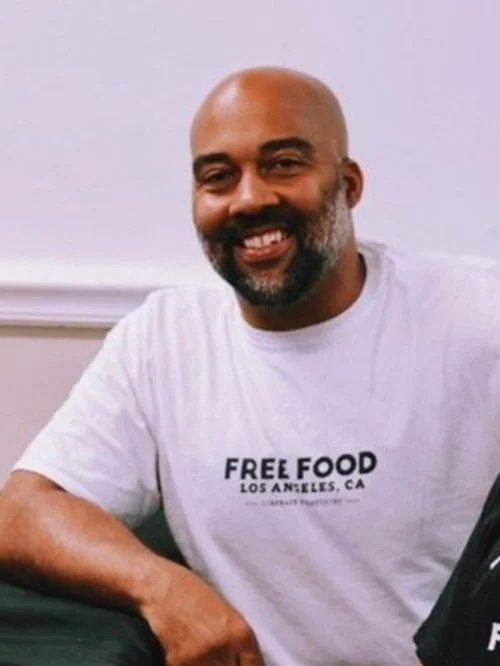
General Manager Matt Sherman took time away from service prep to talk to Carol and David about this five-star, three-course meal provided for free and with care.
“If you can get here, you can eat here.”
Matt and Refettorio Harlem were in the middle of getting ready for their next service at the time of recording. Chef Michael Lesser relies on a team of volunteers to help prep food. But Refettorio also works with community partners to capture “perfectly imperfect food,” reduce waste, and provide to-go baked goods to their guests.
More than providing an amazing meal, Refettorio provides a curated space featuring local artists. With flowers on the table, silverware, and art on the walls, the mission of Refettorio is to remind people that they have the right to beauty.
Carol Jenkins: 00:06 David Ambroz, so delighted to see you from L.A. Thank you for joining the Invisible Americans podcast crew this time.
David Ambroz: 00:14 Wonderful, wonderful to see you and be with you.
Carol Jenkins: 00:18 Well, you know, this is the first time we're doing video for a podcast and I'm hoping we're going to see Luca in the background. At some point or another and for those who don't know The Invisible Americans Podcast, we do the podcast. We also do public conversations, otherwise known as summits sometimes, public conversations, and we do volunteering. And I was telling you about the last time that I was at the West Side Campaign Against Hunger, their drop-off at 86th Street. for when people come. I was on a 1045 a.m. shift, and when I got there, the announcement was a thousand people had already gone through the line. The food pantries in this country are absolutely crying, and so for all of you out there who see this, these are people who are feeding our babies. There's just not enough food to go around, and you understand food insecurity. So, you know, we have small volunteer teams that we go to, to the food banks, you know, as well as, you know, the other podcast and public conversation work that we do. But one of the things I'm so excited about is the work that you are doing in L.A. Talk to us about that.
David Ambroz: 01:40 I will, but thank you for the work that you mentioned. I grew up in New York City, and my family were in those lines. And I think we use words like food insecurity, and it somewhat dims the truth, which is people are starving. And one out of four kids in this country are hungry. We have a hunger crisis, and I think we need to say what it is, which is we are not providing for these kids. And if the kids are hungry, what are the parents eating? Because I know very few mothers in this country that would eat before they feed their children. So thank you for feeding people like me. I'm in LA, and I love Los Angeles, the city of angels. It is my love. I love New York City as well. I don't have a favorite. Don't tell LA. But in this city, we have a tsunami of homelessness. It is everywhere you look. It is in excess of 65,000 people sleeping on the streets of Los Angeles, more than 1,000 of them being children. And we don't have to live like this. Every year in LA, hundreds of foster kids emancipate from the county system into homelessness directly. And so I've been working for, it feels like forever, but more than 15 years to build what I call a foster dorm at a community college. So instead of emancipating kids to no skill, no job, no education, and homelessness, we truly extend foster care to give them a 21st century education and hope, and most importantly, housing and health care. And it is something we are doing in Los Angeles. It's a model, I hope, that goes across the country.
Carol Jenkins: 03:19 Right. And with you at the helm, I know it absolutely well. We always brag about you, you know, Obama, White House, you know, and all for everything that you've done, you know, and the stories you tell. You know, I know New York City, you and your family lived in the New York City subway system when you were a small child. And the reason you know about foster care is that then you went in the system And in your book, A Place Called Home, you describe the horrific things that happened to you there. So I am so glad that you're working on The Dorm. I agree, you know, the kids need more support. So best wishes for all of that as, you know, as we go along. We've got a terrific show today. So let's get to our guests.
David Ambroz: 04:12 In 2021, Holly Fogle started giving cash to expectant mothers in Upper Manhattan. No questions asked. It was a small program, the first guaranteed income program like it in the country. Today it's called the Bridge Project.
Carol Jenkins: 04:26 And today, it has expanded to 12 states with almost 4,000 mothers and babies covered for the first three years of the baby's life. And it has given away $90 million in cash. David, we are so lucky that we have the one and only Holly Fogle in our studio. We know you're in LA. We're here in New York. And I've only missed a little bit of time since the last time I saw this woman. And in that time, she's done a hundred things. And she's going to talk to us about, well, we wanted you to come on to talk about the Bridge Project because we were so supportive of giving mothers cash. And it has just grown tremendously.
Holly Fogle: 05:11 Well, thank you for having me. And I was reflecting back. We had talked, I think, now just a few years ago. And as you said, we had started the Bridge Project in northern Manhattan simply as a way for my husband and I to move our own philanthropic money deep into the hands of women who were pregnant and living below the poverty line. And what happened was pretty incredible, because almost out of the gate, we started to see incredible data coming back from families, which, you know, and people were like, this is radical. You're giving women cash. And I don't think there's that much that's that radical.
David Ambroz: 05:47 Crazy, giving adult women cash. What are you thinking?
Carol Jenkins: 05:51 And very few questions, too, which is the part that I love. You know, there wasn't this in-depth, you know, do you really need it? What are you going to do with it kind of scenario?
Holly Fogle: 06:00 Well, and I think part of that was, you know, I had grown up in Appalachia and I had seen and sort of been surrounded by a group of old church women who fundamentally understood how to take care of each other and frankly, how to make a little go a long, long way. And so I had a lot of faith in women in particular, and certainly in poor people, to know what they need to do with their lives. And so from there, we are today, just five years later, closing in on 4,000 babies. We are in 12 states. We'll be in 14 states by the end of summer. And we're going. That is amazing.
David Ambroz: 06:37 That's incredible.
Carol Jenkins: 06:39 And the last two states that you're looking at, you said you were closing Omaha, Nebraska, and where else?
Holly Fogle: 06:46 Yes, so we just closed Omaha. And what's pretty interesting about Omaha when we were looking at that data is those women were around an income of about $17,000, which, if you think of that, is pretty darn incredible to be able to try to raise a baby on $17,000 in income. But next up is Maryland and then Arkansas.
Carol Jenkins: 07:10 Arkansas. Right, right. Now, and Holly's story, David, you know this, but, you know, from, I love the description, from the end of a long road in Appalachia, you know, you began to think about this country and how things worked.
Holly Fogle: 07:28 Well, and I think to me, it's also part of why community has become so important and infusing so much of the work we've done, because I did just grow up in this little town of 300 people and everybody knew each other. And they also showed up for each other, which, you know, I think now of where we are as a country, it feels important to me to be showing up for our neighbors.
David Ambroz: 07:50 I grew up in a small town, too, called New York City, and I'm struck by a couple of things. One, I've In this country, poverty is women's work. It disproportionately impacts women and disproportionately impacts single mothers. And my mom was one of those. And I think about all the different hoops we have to go through as a society, as individuals, to get help. And it almost becomes more burdensome than the bang for the buck. You can't work. You have to go to these lines. So when you think about the impact you're having, it's tremendous, not just for the cash you're putting in these people's hands, but talk a little bit about how these women are reacting to not have to write the Magna Carta to get a couple dollars. What does that do? How have you experienced, I would call it dignity, in these people that you're helping?
Holly Fogle: 08:40 I would agree with that, David. And I think what we hear, I would say over and over again, is it gives them the ability to breathe. And I think in that, it's certainly dignity, but it also gives them the ability to feel like they are in charge of writing their own story, which feels very American to me, and feels very much like what we know women and parents of children have had to try to do forever, of really trying to write their own story in this world. But, you know, I think that notion of we believe in you, so many of the women have said that was a boost of confidence at a point when their self-esteem and their confidence was at a really low point because you have this baby, you don't have enough money to buy a car seat to bring the baby home. And thinking about that pressure or that stress, I think it does something to your soul beyond just your pocketbook. And so I think a program like Bridge where it says, we trust you, we see you, we know you are going to be an incredible steward of these resources, and frankly, you're the best shot this baby's got. And so we are going to believe in you. I think everybody sits up a little straighter and grows an inch or two.
David Ambroz: 09:48 Yeah, two thirds of the kids entering foster care in America are because the parent families are, quote unquote, neglecting. And that quite often is a euphemism for poverty. And so we've criminalized poverty. We take the kids away. We spend hundreds of thousands of dollars each year. This is a much more strategic intervention.
Carol Jenkins: 10:07 The important thing now is that when you started this, you were the first in the country, you know? I mean, this was a novel, truly novel idea of giving money. And it was 100 babies and mothers, 4,000 now. And is it more than $90 million that you've been able to actually, all of that going to the mothers and the babies?
Holly Fogle: 10:28 Yes. became important is we had started this within our foundation and then we spun it out because we started to see a lot of fellow philanthropist friends who said, hey, we love this idea. We don't have the time to build the pipes that we were building to move the money efficiently and effectively. But could we could we kind of get on board with that? And so pretty quickly out of the gate, we ended up doing Connecticut. And it was two donors, a Republican and a Democrat, who came together and said, look, let's try to reach one in five babies born in Connecticut. And I think from there, it just continues to grow and continues to build momentum.
Carol Jenkins: 11:06 And now you were the first, and then others began to believe in this concept of just give them the cash. What, $300, $1,000 a month, depending upon, I think, the very… It varies. But for a three-year period. And now you've created this coalition. So tell us about that.
Holly Fogle: 11:24 I think what became important to me is, you know, as much success as we're having, it's still small relative to the need in this country. And so we need to be speaking with one voice as much as we can, or at least coordinated voices in terms of research and policy. So we've created something called the Mother/Infant Cash Coalition. which has 39 different organizations in it. And we house it within the Bridge Project, but the members are all over the country doing all kinds of work, not just with babies, but with mothers and children. And what's really important is can we coordinate our research? Can we learn from each other? Can we be coordinated in advocacy and policy work around the states and ultimately the federal government? And so that's been a real joy to see that come together. And the folks in there are just incredible people working really hard to try to understand, to try to get this this message out of, you know, who knew women could be trusted? Who knew? When you give them cash, they do really good things like get out of homeless shelters and feed their babies.
David Ambroz: 12:29 What do you say when people, go ahead, Carol.
Holly Fogle: 12:31 No, no, no.
Carol Jenkins: 12:32 I was going to say she mentioned the word homeless or unhoused. There was a special project that you did with the New York City Council, which was the first time that something like that had happened, where a city actually bought into this concept and with the unhoused.
Holly Fogle: 12:51 This is one of those moments as a New Yorker I was really proud to be a New Yorker. And so we at Bridge, we're always trying to learn because we know cash works, but there's still so much we don't know of amounts and duration and always just trying to iterate and learn in different situations and with different groups of people. So one thing we had been seeing in our broad New York work was that we were seeing women, so our only criteria is you have to be 18, pregnant, and below the poverty line, or 150% of the poverty line. And what we were seeing is we had women in the program who were unhoused when they started Bridge. So in some sort of temporary shelter, city shelter. And what we also saw is they started to get out of shelter at very high rates. And in New York City, we have about 2,000 babies born every year. The most common age to be homeless is one. It cost us as city taxpayers $7,000 a month to house a woman and a baby.
And you could guess she doesn't want to be there. And when a child is born into homeless shelters, the chance that they become homeless later in life is significantly higher with all kinds of other implications. So we, Adrienne Adams was the city council speaker, first woman, first grandma, first black woman. I mean, she just got it as a mother and as a grandmother and said, look, let's see what would happen if we actually specifically went after women who are living in transitional shelter and pregnant. And that kicked off our first really deep city council partnership. I'm happy to report we are on the second cohort of that. And it's been fantastic because, again, when you give women cash, one woman said to us, I think this sort of sums it up, she said, I do not want the address of a homeless shelter to be on my baby's birth certificate. And so you can just bet how hard she was working to get out of that shelter before that baby was born.
David Ambroz: 14:49 What do you say when folks approach you and ask, don't they buy drugs or eat Cheetos or some sort of other thing? Because we can confront people's ignorance with anger or information, but how do you respond to that? Societally, I hear that often enough that we need to be so involved in the decisions of adults in terms of what they spend their resources on to make sure it gets spent right.
Holly Fogle: 15:16 First, in defense of Cheetos, I love Cheetos. Like one of my favorite foods, David.
David Ambroz: 15:19 Hey, I'm not digging Cheetos, but I hear people say they shouldn't be buying soda and Cheetos.
Holly Fogle: 15:25 I'm like, I guess we're not going to get sponsored by Yum Foods. You know, it's a common question. You're right. It's a common question. And I was a McKinsey consultant for many years, so I love data. And what is really powerful is when you look at the data across the world, frankly, not just in the United States, With men or women, not just mothers, you see when folks get cash, all of what is sort of the so-called vice spending, which is alcohol, drugs, it can be gambling, it can be pornography, those categories all go down. And the researchers don't really understand why, but what their best guess is back to this hope, which is hard to measure in a survey, but when folks see that they could reach a goal and that they have an ability to change their circumstances, they want to take that.
And so what we see specifically in a lot of the work we've done is things like smoking goes down. Smoking goes down almost across the board when you give pregnant women cash, which is an interesting public health intervention. I think the other question we get quite a lot, David, is don't they need financial literacy? Like, these folks are poor, you're gonna give them cash. How do they know what to do with this? We have also a lot of studies that show financial literacy interventions for folks who are very low income are completely ineffective. We spend a lot of money on it to very little outcome. And I think when I look at the decisions our moms are making every day, I mean, they're trading off, do I buy diapers or do I buy chicken for dinner? They know how to stretch that dollar so darn, so much further than I would stretch it and know how to stretch it. So I have a lot of confidence in these folks.
Carol Jenkins: 17:11 Tell us about the children's hub, because that is, you know, we're about to sign a lease, and I've seen the property, and as a matter of fact, it's going, this wonderful children and family hub, David, is going into my former church. We used to go to church in Washington Heights, the collegiate, so I've seen it. It's perfect for babies.
Holly Fogle: 17:35 Yes, well, and I think this is another one of my passions. Back to community that we were talking about, and I think is we continue to figure out where are these third spaces that people are able to gather? Because one thing we hear from our rural moms in Bridge is that they are lonely and they miss people. And so that's harder to solve community by community in rural America. But in New York City, my hometown, we have a beautiful new space that's going to be very much towards play, but then a whole set of wraparound services for the women of northern Manhattan. And so I'm really, really excited about that one.
Carol Jenkins: 18:13 I know. And the community is happy. In fact, some of my friends who still, you know, live there, I said, guess what? You're going to have playground equipment in the front yard of the church. And they said, fabulous. That's so wonderful. So it's a it's a tremendous and there will be full services. What's the I know the open date, you think you can do it in September.
Holly Fogle: 18:34 Yeah, we're going to try to do a soft launch for fall. So the children really need it. And I think there's nothing that motivates us more than when we know we have a community in need. And, you know, that's a community rich in immigrant heritage. And often they are living in very, very small spaces, which contribute to all kinds of development delays for the children because they just frankly don't have room to walk. and to crawl and to practice. And we know how important play is for children.
Carol Jenkins: 19:05 David, as a new dad, knows that quite well.
David Ambroz: 19:08 Oh my goodness. I have a two-year-old who I learned the phrase tummy time, which is, you know, I definitely had a misunderstanding when I first heard that. Um, when you, you came from McKinsey, um, I like that you said that, but you know, truly Appalachia, but you worked in McKinsey and I work in the private sector as well. How does that inform what you do now? I think there's some sort of weird conception in the public mind that there's this island of misfit toys called nonprofits that are differently governed. And then there's this other thing and I don't see it that way. I wonder how, how it informs what you do today and, and, um, has helped you.
Holly Fogle: 19:45 Yeah, I agree with you, David. I don't see it that way either. I think, I mean, I will say I use that training every day. I spend a lot of time working with CEOs solving their hardest problems, and I can't think of a harder problem than early childhood poverty in our country, but also it's so solvable. I mean, that's what can make us so frustrated. But I think one skill that I use every day is, at McKinsey, we did something called porpoising, where you would go quite deep and understand the facts and the figures and interview a bunch of people and really understand what was going on the ground. And then you need to come back up to the surface and breathe, which is sort of the strategic question. And I think that we do all day long at the Bridge Project and in these communities we're working in. So we want to be talking to these moms and understanding why only half of them are enrolled in WIC. All of them should be enrolled in WIC. What are those barriers? And then we can bring that back up to create advocacy groups and really help them use their own voices to speak to their local or state governments, which is important.
David Ambroz: 20:44 I think my takeaway is porpoising, that's going to be a verb and I'm going to have to work that into a conversation, but that makes a lot of sense.
Carol Jenkins: 20:51 So what is, you know, as I think about all of the, you need partners. You need a lot of partners to make this work because, you know, in our intro we said you've given away $90 million in cash, all gone to the mothers and the babies. And who, I know that you're a family foundation. You very generously created this, you know, with a $50 million contribution in the beginning. So where, what other partners do you have? It's so critical.
Holly Fogle: 21:20 It's so critical. And I think that's been part of the joy in the last couple of years. And they've taken a lot of different paths. So in Boston, a group of women just came together and said, we want to bring the Bridge Project to Boston. They cobbled together a few anchor funders. And so the goal is always if people can raise $2 million over three years, we'll bring Bridge into their neighborhood. That gives us 100 moms in someone's backyard. And so that's kind of enough of a nucleus to make it worthwhile. And they were like, we will do this. The women of Boston were like two million dollars. Let's go. They have raised close to six.
And we have fully enrolled that cohort in Boston, which is incredible. But I will say over and over again, people have just stepped forward to say, Omaha, you and I were just talking about. The Sherwood Foundation, the Monarch Foundation came together and said, look, we want to really go deep in Omaha. And we've enrolled, and we had almost 1,000 applications for 350 spots that went so darn fast. And I think that one's going to be a really interesting and exciting place to watch. But then another partner is in Maryland, which is one of the newer launches that we have coming up. And we're working really closely with Governor Moore's team. And Jen Gates, Melinda's daughter, has been a really important funder there to put some anchor money in. And so I love this idea of public-private partnerships, working together for things that we care about in the backyard and the places that we care about.
David Ambroz: 22:54 people today seem to be so cynical. And I think cynicism is a luxury that children in poverty cannot have us afford. And instead of being cynical, you did something. And I think all of us, when we think about what our resources are, what we might do, can do something. And you are kind of the embodiment of that. And I'm not asking everyone to give $50 million to a foundation. But all of us can do something. And if you're confused about what to do, we'll link to this organization and you can step up in some way, shape or form to support them. So thank you for being the embodiment of anti-cynicism in this country.
Carol Jenkins: 23:27 Thanks, David. Thank you, Holly, so much for being with us.
David Ambroz: Thanks, Carol. Always a pleasure.
Carol Jenkins: Can't wait to see what you do next.
Carol Jenkins: Official estimates place the number of unhoused people in the United States at about 770,000. Author Brian Goldstone, however, thinks that number is more like four million.
David Ambroz: 23:53 They're people who work every day and still can't afford a home. His book, No Place for Us Working and Homeless in America, just out in paperback. It was a New York Times Best Book of 2025 and one of President Obama and David Ambroz's favorites. Brian, I'm so excited to talk to you today about a topic that is deeply personal to me. I spent 12 years of my life homeless growing up in New York City with my mom. And when I read there is no place for us working and homeless in America, it affected me so much I had to put it down at times. And I think the thing that most impacted me was you spent six years embedded in the lives of five Atlanta families, sleeping in cars, extended stay hotel rooms, surviving the churn of bureaucracy while they were holding down jobs. And what I was most struck by in the books that I've read is I felt like most authors and journalists kind of parachute in. follow for a minute, but you stayed and chronicled something really profound. And I wondered if you'd talk a little bit, what kept you there and what kept you at this story for such a sustained period of time?
Brian Goldstone: 25:09 Yeah, thank you. Thank you for those incredibly generous words. And thank you for having me. It's really an honor to speak with you both. You know, I did an event shortly after the book came out with a hero of mine. Her name is Sarah Nelson. She's the head of the Flight Attendant Union. She's just a labor dynamo, a force of nature. And, you know, she read my book, and she said that when she finished reading it, it occurred to her that before we can fix this crisis, we have to feel the crisis. We have to feel this crisis in a really visceral way. And, you know, in retrospect, I think that was kind of the guiding impulse behind the reporting method, behind what you described, this attempt to just immerse myself as much as humanly possible in the day-to-day lives of the five families who I follow in the book. You know, I think that words like homelessness so easily become abstractions. They become a headline. They become a word or, you know, the homeless crisis, the housing crisis. They become phrases that maybe once packed a punch, maybe once stopped a short, maybe once were a scandal. But they've ceased to become that, and they've become normalized, they become routinized, they become quotidian.
And I knew that if this book was going to mean anything, it would be because readers were forced to travel with these families, to walk in their shoes, to see through their eyes, to see, you know, not only what it's like to be working and working and working some more, to feel that you can clock It doesn't matter how many hours you clock, it's not going to be enough. Not only to feel that, not only to feel what it's like for parents and for their kids when this most basic human necessity, a roof overhead, is constantly out of reach, but to really feel how at every turn in their journey, in their experience, there are all these systems and structures just actively militating against their stability. And I think that's the kind of thing that needs to be shown rather than just said. It needs to be felt rather than just understood. To be clear, it does need to be understood.
As much as I appreciate the feedback that from readers that it felt like a novel or felt that the storytelling just pulled them in, I'm so grateful for that kind of feedback because I was absolutely going for that. I wanted readers, as I said, to be swept up. But, you know, one frustration that I've had in reading some really beautifully written works of reportage is that you get to the end and it's like, well who's to say what caused the suffering? Who's gonna say what caused this homelessness or this poverty? And kind of leaving it for the reader to connect the dots, and I didn't want to do that either I didn't want to fall prey to the opposite temptation, you know to like just immerse just tell a story and to make the reader feel. It's very important that I, as a reporter, am the one who, even when the families themselves aren't able to see it themselves because they're so in it, that I'm stepping back and saying, actually, it's not your fault. Actually, the choices were already predetermined, and you were already boxed. So that's very much what I was aiming for.
David Ambroz: 29:05 Well, bullseye, I – and building off that, these folks weren't failed by a struggling economy. I think first of all when people hear working homeless, it's sort of an anathema. It's just – wait, wait, what? But they were, they were failed by a thriving one. They were displaced by a thriving economy. And there was no room at the inn, quite literally. And I wonder, for someone who constantly might hear, you know, hard work is the answer. What do you say to those folks? And what do you hope they take away from a book like this?
Brian Goldstone: 29:43 Well, I knew from the beginning that in focusing on what I've come to refer to as the working homeless, that it ran the risk of reinforcing a really old and pernicious binary, a really old and pernicious sort of division, not only in America, but going back to Victorian England, of distinguishing between the deserving and the undeserving poor. And I'll just say up front that one reading of this book that You know, I find really difficult. I've gotten this response at public events is almost something. I mean, it's not quite this crudely put, but it's like, well, thank you, Brian. Thank you for showing us the folks who are working, the folks who are doing everything right. A largely invisible, largely hidden population. I can now feel sympathy for them while continuing to sort of indulge all of the stigmas and stereotypes and in concrete terms, the criminalization of people who are unhoused on the street.
And of course, I want to push very vigorously against that kind of misreading. In focusing on the working homeless, all I'm really trying to say is this is an empirical fact. This is an empirical reality. that not tens of thousands, not hundreds of thousands, but millions of American workers, people who are part of this nation's labor force, they are, you know, they have gone into this with a kind of tacit contract, a tacit agreement that if you do this, if you show up for work, if you manage all of your… You will make it. You'll make it. You might not be rich, you might not be able to own a mansion, But you'll at least have your most basic material meets men. That's right. And these family stories just show the social contract. How broken that contract has become. Absolutely. Yeah.
Carol Jenkins: 31:52 Brian, we're so lucky that you are such a gifted writer. I know that I had to go back to your editor's note at the beginning to say how How did he do this? I mean, that you so eloquently expressed the pain and the suffering and the fact that they were not at fault. And one of the things, I'm still taking notes as you're talking here, but one of the things you say in the book, you were describing someone who was in deep trouble because her particular form of homelessness did not count. You know, which really gets, yeah, you may not have enough food, you may not have a decent house to live in, but you don't quite fit the need to get any assistance here.
Brian Goldstone: 32:33 One realization that came to me in following that particular person's story, Celeste, She, you know, goes to the coordinated entry point, which in Atlanta is called Gateway Center. It's the hub for homeless services. It's where you have to go if you're homeless and you're seeking assistance. And exactly, you know, she goes through the assessment and she's told, you know, because you're living in this extended stay hotel, you don't, even though the school district, even though the Department of Education counts you as homeless, considers you homeless. HUD, which determines actual housing assistance, does not consider you homeless. So I'm sorry, ma'am. I mean, in effect, she was called, I'm sorry, you're not homeless in the right way. And it occurred to me that the only thing worse than being homeless in this country is not earning the designation homeless, because then you are truly left to fend for yourself.
And this population of folks who belong to what I call the shadow realm of homelessness, this invisible population, a population that isn't just invisible or hidden, but I've even come to think of it as a kind of engineered invisibility, a very intentional invisibility. This is not just like a marginal, you know, a marginal faction of the total homeless population. I show in the book that what we see on the street is really just the tip of the iceberg and To continue with that iceberg metaphor, you know, that population under the water surface is much, much, much bigger. And those are families, largely with kids, largely in the workforce, who are in their cars. They're doubled up in overcrowded apartments with others. They're in these, above all, in these extended stay hotels. And every year when the homeless count is conducted, which is mandated by HUD, these families, and again, the millions like them, they literally don't count. They have been written out of the story that we tell ourselves about homelessness.
And yeah, fateful consequences, not only for the families and individuals who are locked out of assistance and really, as I said, just left with nothing, left with no help, left to languish in this kind of semi-permanent state of limbo. But it has fateful consequences for our understanding of homelessness. When all we're looking at is what's on the street, we have this tiny little sliver. It's like our lens has been narrowed. and the focus has been blurred. But when we expand the lens and we adjust the focus, not only homelessness, but America itself and the American economy and what's driving it begins to look very different. And that really leads me to the second part of your question, which is that this is a crisis not of joblessness. It is a crisis of jobs that do not pay enough to live, that do not pay enough to survive.
And it's, you know, and it's important to note that it isn't just wages. It's not just the growing chasm between what people are bringing in with their incomes and what it costs to have a place to live. It's also, as you noted, that the nature of work itself has become increasingly precarious and volatile and insecure. So that, yeah, Cass, who's cleaning, you know, the floor at the Atlanta airport overnight, is given 29 hours a week because at 30 she would be eligible for health insurance and sick leave. So the gigification of work is just as important to take into account as, in many cases, the poverty wages that our workers are earning.
David Ambroz: 36:26 First of all, there's a story I tell in my book about my mom, and we went to get housing assistance, and we were homeless, and they asked us for our home address. And then the other mind thing I couldn't wrap my head around was they asked a woman who was single with three children, are you looking for work? And my mom looked at them and was like, I have three kids. Do you have assistance for childcare? And so she was sort of trapped in this thing. I was thinking back, as you were talking a little bit, to the story of Celeste. You know, rehearsing her story all morning that she's going to sit down and tell this caseworker, you know, ready to explain everything, convince them. And the lack of humanity, the caseworker politely, as I recall, stops her. and says, I don't want the narrative. I only want yes or no. As if all of us and our experiences can be boxes that could be simply checked. And here's this woman with a complicated life and a family, and she's been reduced to a box. I wonder if you could just riff on that a little bit, that experience.
Brian Goldstone: 37:38 Yeah, no, it's very important insight. I mean, I think that is part of what was so brutal about that moment. It's that, you know, to watch Celeste as she is lined up at, I think, 4.30 in the morning, joining a line that is already circling the city block in downtown Atlanta. You know, the parents with strollers coming with their kids, waiting in line outside. And as she's standing there in line, she's rehearsing what she's going to say. She's going to tell her story, she's going to talk about the fact that she is homeless because not because her rental home burned down, which it did. That was sort of the first domino that fell. But really what led Celeste and her children to be pushed into homelessness was that months after her rental home burned down, the private equity firm that owned her home, that was her landlord, said that she found out that they filed an eviction against her after the house burned down because she was refusing to pay rent on that house that burned down.
And when she refused to pay rent, they filed an eviction, but she didn't find out about it until months later, at which point her credit score had been tanked and she was effectively locked out of the formal housing market and forced to go to an extended stay hotel. She was going to tell the case worker all of this. She brought the birth certificates, the police records, all of it. And yeah, the question she was asked had nothing to do with her, nothing to do with her reality. The questions were like, when was the last time you were incarcerated? Have you ever had HIV or AIDS? Have you been diagnosed with a behavioral health disorder? And if so, what was your diagnosis? How often do you use needles when using drugs, you know, things like that. And all the things that Celeste was so proud of, her work ethic, the fact that she, you know, didn't drink, didn't do drugs, those things she realized were actually making it less likely that she would receive help because her vulnerability score would have actually been higher had she...
David Ambroz: 39:51 vulnerability score.
Brian Goldstone: 39:52 Vulnerability score. And get this, here's the kicker. When Celeste walked into that office that day, she herself had been given a diagnosis of ovarian and breast cancer. She herself was already well into chemotherapy. She was having to decide, do I go to my warehouse job or go to my chemo appointment because I don't have sick leave? And if I don't go to my warehouse job, I don't get paid. And if I don't get paid, me and my kids are going to be out on the street. That is what Celeste was carrying when she went into Gateway that day. And even when she, in this very degrading way, had to use her cancer and say, ma'am, what about my cancer? Doesn't that make me vulnerable? The woman said, I'm sorry, that isn't one of the markers of vulnerability that we use. And so, I mean, just, it's like just the bureaucratic,
Carol Jenkins: 40:48 Well, you know, Brian, every single child of poverty that we have who are adult survivors like, you know, has that same story to tell of watching their own mother have a nervous breakdown trying to either literally or figuratively trying to fill out the paperwork in some government office. And that we consider just a total scandal.
Brian Goldstone: 41:13 And just really quick to that point, I'm so glad you mentioned that because another really important insight that came out of my reporting for me just personally. And one of the really valuable aspects, I think, of doing the reporting over such a long period of time is that I saw that just as often mental health issues, substance use issues are a consequence of a form of insecurity, a consequence of homelessness, not its cause. I mean, of course, it can be a cause. But I saw how, like you said, the toll, the mental, emotional, psychological toll that all of this takes on people. And, you know, Michelle, by the end of the book, she's an amortization in the throes of alcoholism. But when the book started, she was cooking dinner for her kids on Christmas Eve. And it's just an example of how, you know, when we when we only see someone in a particular moment, we don't see the million tiny steps that led them to that place.
David Ambroz: 42:19 I think one of the keen insights I've had in the book is twofold. One, we should all be collectively ashamed if we need help. And I don't know how that culture came about, but we need to change it. And then second, we have begun to fetishize process over people. And we have become check boxes as opposed to people. And when you begin to say to someone, you're not homeless enough to qualify for help, you and your children, I think collectively we should look in the mirror as a country and say, shame on us. We can do better. That's it. And we are better than that. And I think again and again, the humanity you show through these people's stories was breathtaking. And as a formerly homeless person, I think that one of the most honest portrayals I've seen in writing. So thank you for sharing your story.
Brian Goldstone: 43:06 Thank you so much. I appreciate that.
David Ambroz: 43:08 Thank you. Thanks. It's known as Refettorio Harlem, where top chefs design very fancy three-course meals. But unlike other fancy restaurants, it's not a pricey one. Everything at Refettorio is completely free. You heard me. No questions asked.
Carol Jenkins: 43:33 And so far, 20,000 meals have been generously served to the food insecure with love, with flowers on every table, and with dignity. Matt Sherman is the general director. Matt, thanks so much for taking some time out of your busy schedule as we record this. I know that it's a Friday night and you are about to receive a mass of very hungry, very grateful folk who are coming to a three-course meal. And we said, we were kidding earlier that we want David to come in from L.A. so that he can volunteer. Like Holly and I, my sister was the one who told me about you all. We served two settings the night we were there, and that's a workout. Thank you so much for being with us.
Matt Sherman: 44:19 Thank you for having me. Yeah, it's like an Olympic flow event every time.
Carol Jenkins: 44:25 That's precisely it. It's an Olympic event, David.
David Ambroz: 44:28 Every night. The gold medal goes to Matt Sherman.
Matt Sherman: 44:33 And team. And team. Yeah, yeah. Big team. We have a lot of really, really powerful volunteers there. And we couldn't do it without, yeah.
David Ambroz: 44:44 Matt, I had to look up how to say refettorio, and I was trying to find out where it came from. And I don't know if you've had the chance to AI that word, but it was a little surprising to me. It comes from the Latin word refirse, if I say that correctly, which means to restore. And I was really, I don't know if that's intentional, but when I was looking at some of the words you've put out in the public and things you've shared, I couldn't think of a better word than the restoration of human dignity and personhood. And I wondered where that came from and how you landed on that.
Matt Sherman: 45:20 So it's so interesting. I didn't know that. So I'll just give you a little bit of background. And it's just this, that's… Just another example of how like all of this, I don't want to get woo woo, but it's like just all in alignment. It's just all been in alignment. So, um, my organization is a free food Harlem. It's our, the food program under our nonprofit unconditional freedom. So we've been in New York about five years and some friends started it in their apartment. They were handing out burritos on the street and using neighbor's ovens. And then the meals kept getting more elaborate. Then they eventually started going to churches that had kitchens, and they would set up a dining room, break it down, set up a dining room, break it down.
And then we went through a number of churches here in Harlem, and we finally, after our last church, founded Refettorio. So Refettorio is an organization based from Food for Soul, is the nonprofit who runs Refettorio, and started by Massimo Bottura and his wife, Laura. Giltmore, they started in Italy and it is an Italian word and the vision is the same as Free Food Harlem, which is restoring and rehumanizing the dining experience and just the community experience in general. Believing that we can get people to the level of thriving and flourishing when they have these basic needs met. And those needs not just being food, but dignity. and creativity and humanity. And so that's where we, with Food for Soul, come together and run this refettorio. So refettorios are all over the world and in each refettorio they have a local operator who runs it. And so Free Food Harlem runs this refettorio. So powerful.
Carol Jenkins: 47:05 Yeah, we should emphasize, you know, that unlike so many other places where it is possible to get free food or at food banks, et cetera, at Refeterio, you do not have to show any paperwork at all. There are no questions asked. And when you walk into that dining room, it is set with flowers on the table, real silver, beautiful dishes and a three course chef created meal.
Matt Sherman: 47:32 That's it. Yeah. No barrier to entry, first come first serve. If you can get here, you can eat here. We don't try to evaluate your need. It's like, because there's so many different kinds of needs. Like I said, like food is just one of them. Some people just are avoiding social isolation, getting out of the house and actually dining with friends. Like this has become a place for family for so many people.
David Ambroz: 47:56 It's Friday night, I have a two and a half year old, and I know what my Friday night's gonna look like. There's a lot of spaghetti on the floor. So I wonder if you'd walk us through what's the Friday night ahead of you look like there, and what's on the menu, how are you preparing, what's going on there right now?
Matt Sherman: 48:15 All right, so we get in here it's we get in here about 10 in the morning our Chef Michael Lesser. He's in the kitchen with a whole team of volunteers. They're going on prep now for tonight's meal prep started yesterday, but they would have been slicing potatoes. I think there's a asparagus salad that's the starter tonight. Yeah, it's and then they're going to roast the potatoes. And then it's a we tend to do fish on Fridays as a trend. And so there's a baked white fish dish that's going out with the main. Yeah. And so that's all being prepped now.
And at the same time, we're getting in donations as we speak. So there's a lot of local. So one of the big part of our mission and Food for Souls mission is restoring dignity to people, but also to food. So there's food that would have been thrown out. And we have a partner called Baldor here who provides food for most of the restaurants in the city. And so there's food that they cannot use and cannot sell, but there's nothing wrong with it. It's like the perfectly imperfect food. So there might be a tear in the bag or just close to expiration for them, but not for us.
And we take that and keep it out of the waste stream and get it into our kitchen and turn it into the meal so that food is being prepped but also we have bakeries locally who provide us with baked goods that are just a day old that they just can't sell and so instead of throwing them out we're able to give those out to our to-go meal guests tonight so those are coming in behind me there's people packing up those cookies getting ready for tonight that they'll give those away we have um
Carol Jenkins: 49:54 We just got 110 pounds of gluten-free dairy-free baked goods from uh by the way bakery here yeah yeah thanks so it's very very nice listen one of my first assignments when i went there man i don't know whether you remember you have so many volunteers we should talk about that too but i was assigned the uh the decor room where we were decorating the bags, the to-go bags, you know, that we would be taking, and the instruction was to write, you are loved, and to decorate it in whatever way you wanted. It was just so fantastic.
Matt Sherman: 50:31 That's, oh, go ahead, sorry, David, you were gonna say?
David Ambroz: 50:34 I just love, you said perfectly imperfect. I just thought, you know, isn't that describing all of us? What made you decide dignity was a core ingredient there? Flowers, tablecloths, three-course meals? Why was dignity to you such an important ingredient?
Matt Sherman: 50:51 I think because that is the, that's the missing element. So like part of our, our mission is like, um, fighting all those like outcasted, um, areas of society. So whether it be, uh, we work a lot with the justice impacted and we, yeah. And so like working with groups like that, you start to realize what has been stripped from the unhoused is like from the justice impact. It is that, so they have their dignities, but there's a place where it's like helping them remember. it when it's been forgotten and rehumanizing is the thing I like to say is just like remembering that they're human. I love the like the the name of this, in the like Invisible Americans. it's like being seen you know that that's a part of dignity is like being seen coming in here you're used to people just ignoring you on the sidewalk whether housed or unhoused, you know, we're in New York city. There's just, sometimes there is a way that people are just tunnel vision, you know?
So there's a, there's a way that coming here, you get to be seen and remember your dignity, remember your creativity, your purpose and all of that. And then once you're fed, you can actually think about those things. Oh, sometimes, you know, you're, if you're too focused on food, you're not the dignity. What? They just, you know, let me feed this. This first hunger is my stomach. So we, we just hit all of those all at the same time.
Carol Jenkins: 52:12 Matt, talk to us about the volunteer aspect of it. I've been there some nights when there have been tons of people who, you know, are just so eager to be a part of the experience.
Matt Sherman: 52:23 Yeah, it's key, we could not do it without volunteers. We have volunteers throughout the day, some here in the front of house, putting out those cloth napkins you talked about, writing all the bags, polishing flatware.
Carol Jenkins: 52:38 I know, I know. And you sometimes have two servings, so it's almost what, 600 meals a week that you're providing or more by now.
Matt Sherman: 52:50 Probably up to 700 now, and we're about to add a third night. We're going to add a night focused on children and families, actually. Oh, excellent. Right? So our meals have a lot of regulars. They're full, and it is seniors and adults majority right now. And so we're going to do a third night starting on Thursdays, which will focus on children and families.
Carol Jenkins: 53:17 David and Luca, we're going to expect you.
David Ambroz: 53:19 Oh my gosh. You know, I was just thinking about it. You know, my family grew up in New York City. We grew up homeless. And I wrote a book, a memoir. And the first words in the memoir I very thoughtfully wrote are two, I'm hungry. And it was the calories that were the morning, noon, and night that we just, so much of our life was built around. I'm sure I passed by the church there. I am a little taken aback, you know, a church, basement in Harlem, Gucci fabrics on the wall, truffle pizza, oxtail, I had to look that up. You had me at eggnog cake, that was somewhere on the internet. I was like, okay, eggnog cake, I had to look that up. And it's all free. And I think there's something almost radical about beauty in a place where people expect not beauty. And I think it's deliberative. I wonder if you talk a little bit about like, you know, a deliberative provocation is what I thought when I was reading the menu and the setting you've created. It's a beautiful provocation.
Matt Sherman: 54:19 Yeah and so like yeah that's the you know combo between us and Food for Souls’ mission, so if you I'll just kind of – I can show you a little bit too yeah look at the background you see the art on the wall here. It's Tyler Balan, and then there's local artists also featured. We have down the hallway there, you see more art. And then, like you said, there's a radical, it's just remembering, because there's artists in all of us. We're all creators, right? And whether it's through food, we write, we sing, we just, there's so many ways that you can be creative. But to have that around you and to inspire it is what we, is the provocation.
And that you also deserve it, that you have a right to that beauty. You don't have to go to a five-star, well, you know, I like to say we are a five-star restaurant. You don't have to go spend like you would at a Michelin restaurant to receive that type of beauty. And you can have access to it here at this, like you said, is the first floor of the Old Emanuel Church here in Harlem. And Food for Soul, like you said, puts a lot of work into it. They really restored this room, reupholstered the old church chairs with a Gucci fabric, like you said. And there's a, there's a big wall mural here by JR and a parlor room. That's, it's, it's a, it's a view and a full commercial kitchen. Like it is, it is set up to serve like all the things we say we want to do.
Carol Jenkins: 55:45 Well, Matt, you are doing, well, God's work, you know, but, you know, and so welcome for everyone. I can, I know that the food is wonderful, but also just the experience of dignity, you know, just the experience of kindness, you know, which is often so hard to find these times, you provide it. And so we thank you so much for what you're doing.
Matt Sherman: 56:14 Thank you. Yeah, thank you for seeing it, being a part of it, and telling the world about it. And I hope you can make it over here. Great. See you soon. See you soon.
David Ambroz: 56:22 Go get that oxtail going. I hear it's quite a beast to prepare.
Matt Sherman: 56:25 Hope to meet you in person and hope to see you again. Thanks, Matt. Thank you.
David Ambroz: 56:37 Thanks for being with us. Be sure to check out and subscribe to our YouTube channel. For the first time in four seasons, you get to see our faces while we talk and discuss poverty. What could be better? Make sure you check that out. YouTube channel for invisible Americans.
Carol Jenkins: 56:52 Yeah, and I'm really loving this, you know, new growth. I know you, you know, David, you have a two-year-old baby, so that's why, but it's looking really good. You can also find more information about our guests and we have show notes and all of that and about the podcast and the other events and volunteering that we're doing on our website, theinvisibleamericans.com. Thanks for being with us today. We will see you the next time.
Co-Founder & President of The Bridge Project
Holly Fogle grew up at the end of a dirt lane in a coal miner’s house in Appalachia, where she witnessed both poverty and the extraordinary power of a community of church women. Holly is the co-founder of The Bridge Project, our country’s first direct cash program designed to support babies living in poverty during the first 1,000 days of their lives. She also co-founded Nido de Esperanza, a non-profit serving immigrant families living deep below the poverty line in NYC.

Author, There is No Place For Us: Working and Homeless in America
Brian Goldstone is a journalist and author of There Is No Place for Us: Working and Homeless in America, a finalist for the Carnegie Medal for Excellence in Nonfiction and named one of the 10 Best Books of 2025 by The New York Times and The Atlantic. His longform reporting and essays have appeared in The New York Times, Harper’s Magazine, The New Republic, and The California Sunday Magazine, among other publications. He received his PhD in cultural anthropology from Duke University and was a Mellon Research Fellow in the Society of Fellows at Columbia University. In 2021, he was a National Fellow at New America. He lives in Atlanta with his family.

General Manager, Refettorio Harlem
The Invisible Americans Podcast, Inc is incorporated as a 501(c)(3) non-profit organization.
More information at the Charities Bureau Registry.


